New techniques in resolution of singularities
Abstract.
These are notes taken during a talk by Michael Temkin at AGNES on November 21, 2025. His abstract is reproduced below.
Since Hironaka’s famous resolution of singularities in characteristic zero in 1964, it took about 40 years of intensive work of many mathematicians to simplify the method, describe it using conceptual tools and establish its functoriality. However, one point remained quite mysterious: despite different descriptions of the basic resolution algorithm, it was essentially unique. Was it a necessity or a drawback of the fact that all subsequent methods relied on Hironaka’s ideas essentially?
The situation changed in the last decade, when logarithmic, weighted and foliated analogues and generalizations were discovered in works of Abramovich-Temkin-Wlodarzcyk, McQuillan, Quek, Abramovich-Temkin-Wlodarzcyk-Belotto and others. At this stage we can already try to figure out general ideas and principles shared by all these methods and the picture is quite surprising – it seems that each method is quite determined by its basic setting consisting of the class of geometric objects and basic blowings up one works with. In particular, the classical method is probably the only natural resolution (via principalization) method obtained by blowing up smooth centers in the ambient manifold.
In my talk I’ll describe the settings and the methods on a very general level and will add some details about the classical algorithm, the logarithmic one and the simplest dream (or weighted) method, which has no memory and improves the singularity invariant by each weighted blowing up.
1 Introduction
Let be a (singular) variety, analytic space, or scheme. Our goal is to produce a morphism which is proper, birational, and generically an isomorphism, such that is smooth. We might also want to do this logarithmically or require some level of functoriality. We will work in characteristic zero. There are some results in positive characteristic, but we are still very far from resolution of singularities for general varieties.
Example 1.1.
Some examples include the resolution of a nodal cubic by , a cuspidal cubic by , or the cone over a conic by the total space of .
1.1 History.
This was first considered for surfaces by the Italian school and was completed rigorously by Zariski. The next major result was by Zariski for threefolds, and then Hironaka in 1964 proved resolution of singularities in characteristic zero in any dimension. Giraux introduced the notion of maximal contact while Hironaka introduced idealistic exponents. Later, Bierstone-Milman and Villamayor made this notion canonical. In 2003, Wlodarzcyk improved canonical to functorial, and in 2006 Kollar wrote a book and gave a graduate course with a simplified proof.
1.2 Functoriality.
We want our resolution to be functorial with respect to smooth morphisms. In particular, if is a smooth morphism, then we want the diagram
to be cartesian. One advantage of this is that we can work locally on . Hironaka’s original proof was existential and therefore not functorial, so we want to find a method which is both effective and functorial.
One major advance was due to Abramovich-Temkin-Wlodarcyk, who constructed resolutions of morphisms in 2017. This requires logarithmic geometry and we need toroidal singularities, but it did give a more general notion of functoriality. This also required us to work with stacks, and a method using stacks was developed independently by Abramovich-Temkin-Wlodarzcyk and McQuillan in 2019. These two were unified by Quek in 2020 and extended to filiations by Abramovich-Belotto-Temkin-Wlodarzcyk in 2025.
2 General principles
We will consider some general principles which can be seen by study of all of these methods.
- (1)
The context (notion of space, smoothness, and basic modifications) determines the method. In fact, it seems that the algorithm is essentially determined by the context.
- (2)
We should make our method as functorial as possible. This restricts us, but it restricts us in the correct direction.
- (3)
Our rough idea is to locally embed our singular into a smooth ambient space and modify as
such that is smooth. Formally locally, there is only one embedding of minimal ambient dimension. We will consider blowups of smooth centers in the . Note that if is smooth, the blowup replaces with the projectivization of the normal bundle of inside .
- (4)
What we really do is principalize the ideal . What this means is that we find blowups
such that is the blowup in a smooth center. We also require that satisfies that . In particular, we will see that
Theorem 2.1 (Main theorem).
A functorial principalization algorithm exists.
The following corollary follows by a miracle.
Corollary 2.2.
Resolutions of singularities exist in characteristic zero.
In fact, is smooth, so we have resolved the singularities of .
Remark 2.3.
There are two main problems in birational geometry. One is resolution of singularities,1 which says that every birational class of varieties has a cofinal class of smooth varieties. We in fact have
In addition, blowups in smooth centers are cofinal among all modifications.
Example 2.4.
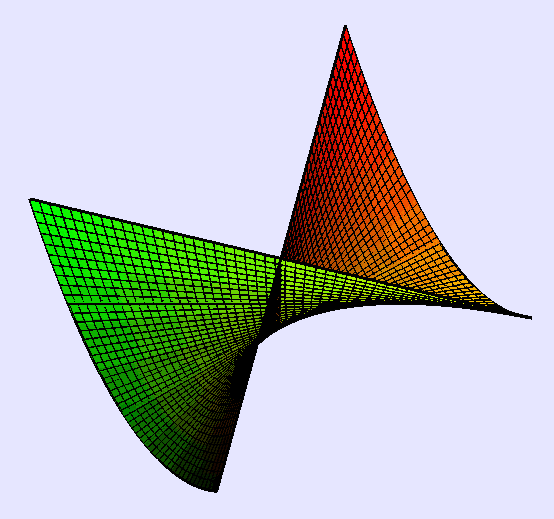
Consider the Whitney umbrella
which is shown in Figure 1. Let be the singular locus. Taking the blowup at the origin, the chart has coordinates , , and . The strict transform has equation
so the singularity does not improve. However, if we blow up , we can resolve the singularity in one step. Therefore, Hironaka’s algorithm requires some notion of memory. There is no algorithm which only modifies the origin and makes normal crossings.
3 Classical method
We will choose smooth centers but set . The primary invariant of this method is
where is the sheaf of derivations on . We also need to consider the coefficient ideal
We also need the notional of maximal contact at a point such that , which is any of order . Then is the maximal contact hypersurface which is the best smooth approximation to our ideal. Lastly, the miracle is that the order reduction of is equivalent to the order reduction of on .
Example 3.1.
If , and is a monic polynomial, then . Then if and only if for all , so this is equivalent to .
One complication is that the inequality may be strict. For example, the equation has order , but if we remove the order increases. To fix this, Hironaka required us to remember the exceptional divisors, which are simple normal crossings. We will not discuss how he does this, but it makes the algorithm more complicated.
The final invariant of Hironaka is , where the center is where is the order, is the maximal contact, is the order of , is the maximal contact, and so on.
4 Dream algorithm
We begin with the observation that if we work with Deligne-Mumford stacks, can define a smooth with center . This is known as a weighted blowup.
Example 4.1.
The blowup is the quotient stack , which is a cone (remembering the stabilizer at the origin). Of course the coarse moduli space is singular, but the stack is smooth.
Theorem 4.2.
- (1)
For any nonzero on a smooth , there exists a unique such that is maximal in the lexicographic order.
- (2)
If we define and , then the order improves in the lexigraphic order.
Example 4.3.
For the Whitney umbrella, we consider the weighted blowup which gives , , and . Then the strict transform is
which is normal crossings. The order begins as , which is greater than the new order in the lexicographic order. This weighted blowup replaces with , so the ramified cover becomes unramified with the stacky version of .